Stage 01
Myeloid
Signature BML+
AML, MDS and MPN, therapy-related and transformed disease, with staged reporting so the findings that change the first cycle arrive first.
See BML+
If this is where you are
Newly diagnosedReports arriving, no plan yetAlready tested elsewhereYou have results you cannot readOn treatment nowYou want to know it is workingOr
Finished treatmentWatching for anything left behindWorried about familyInherited risk, and relativesWanting a second opinionA decision you are unsure aboutDecide
Blueprint CareThe flagship decision report and a dedicated clinical teamSignalOne free question answered on WhatsApp within four hoursNavigationRecords you already have, turned into a clarity timelineDecipherInterpretation of sequencing already done elsewhereTest: solid tumour
All Signature testsEvery panel compared, side by sideSignature STb33 genes from a blood drawSignature STb O118 genes from blood, including fusionsSignature STb O+523 genes, with TMB, MSI and pharmacogenomicsSignature STt OComprehensive profiling from a tissue blockTest: blood cancer
Signature BML+Myeloid, 600+ genes, with MDS and MPN overlapSignature BLL+Lymphoid, 600+ genes, with Philadelphia-like detectionSignature CustomDesigned around one question when neither family fitsMonitor
SentinelSerial monitoring while treatment is runningSentinel SolidctDNA monitoring for solid tumoursClearMolecular residual disease surveillanceClear SolidTumour-informed surveillance for solid tumoursClear BloodResidual disease surveillance after blood cancer treatmentProtect
HeritageInherited risk, assessed properlyHeritage CoreA broad inherited-risk assessmentHeritage AdhocFocused testing for named relativesCancer DictionaryWhat is discussed in your specific cancerReference
Cancer DictionaryOne structured entry per cancer typeBiomarker LibraryOne page per marker, in plain languagePatient ResourcesGlossary, guides and how to use themWatch, read and ask
Video LibraryShort explainers, captioned and translatedJourneysFour composites showing how a decision gets madeCase studiesNine situations and the test that fits eachFAQThe questions we are asked mostPillar 2 · the tests that feed a decision
Molecular tests for solid tumours and blood cancers. Each reads the DNA of the cancer and feeds the result into Blueprint Care, where it becomes a signed decision.
The molecular tests
Signature reads the DNA of the cancer, from a blood draw, a bone marrow sample or a tissue block, and feeds the result into Blueprint Care where it becomes a ranked, signed decision.
Signature is the test. Blueprint Care is the decision.
Solid tumour and blood cancer
Two assay families, because solid tumours and leukaemias are driven by different biology and need different panels, plus a custom route for the questions neither catalogue answers.
Blood cancer
Designed for one question
Lineage decides, not breadth
There are two Signature B panels and both read more than 600 genes. The choice is lineage, not how much breadth the case can justify. BML+ reads myeloid disease and carries the lymphoid genes an ambiguous presentation needs; BLL+ reads lymphoid disease and carries the lymphoma overlap.
Stage 01
Myeloid
AML, MDS and MPN, therapy-related and transformed disease, with staged reporting so the findings that change the first cycle arrive first.
See BML+Stage 02
Lymphoid
Lymphoblastic leukaemia and the lymphoma overlap, with Philadelphia-like detection, copy number and clonality.
See BLL+| BML+ | BLL+ | |
|---|---|---|
| Lineage covered | Myeloid, with lymphoid overlap | Lymphoid, with lymphoma overlap |
| Genes read | 600+ | 600+ |
| Point mutations and InDels | Yes | Yes |
| Fusions and rearrangements | Yes | Yes |
| Copy number | Yes | Yes |
| Philadelphia-like signature | Not applicable | Yes |
| MDS and MPN overlap genes | Yes | No |
| Lymphoma overlap genes | Limited | Yes |
| Germline predisposition flags | Yes | Yes |
| Clonal architecture | Yes | Yes |
| Monitoring baseline | Yes | Yes |
| Staged urgent reporting | Yes | Where the presentation is acute |
Signature Custom
Some questions are not on any catalogue. A rare sarcoma defined by one fusion, a glioma whose classification depends on IDH, 1p/19q and MGMT together, a GIST where the exact exon changes the answer, or a research programme with fixed requirements. For those, the panel is designed around the question instead.
By the question you need answered
Stage 01
Fastest
33 actionable genes and 13 fusion genes from blood. For urgent decisions.
See STbStage 02
Baseline
118 genes from blood. Broad, and the baseline Sentinel monitoring needs.
See STb OStage 03
Fullest
523 genes plus copy number, fusions and signatures. The complete liquid-biopsy picture.
See STb O+Stage 04
Tissue
Comprehensive profiling direct from an FFPE tumour block.
See STt O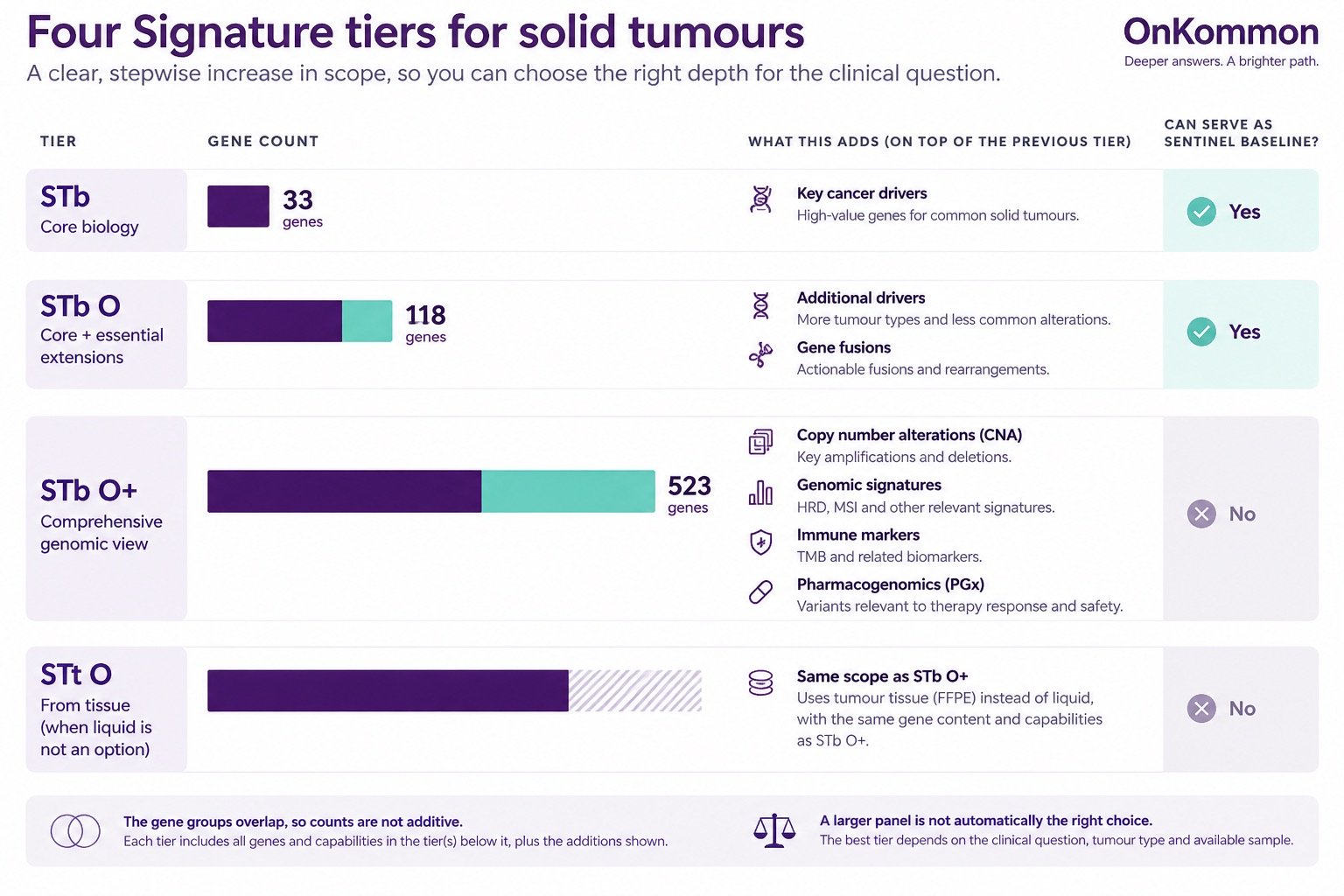
No confusing add-ons
The markers your doctor needs are built into every tier, not sold separately.
SNVs and InDels across the tier’s gene set.
Rearrangements for the relevant targets.
TMB, MSI and MMR reported on every tier.
The 35-gene drug-response panel.
From the 118-gene tier upward.
How much tumour DNA was present, so results are read in context.
35 genes, every tier
Beyond what drives the cancer, we read how you are likely to handle the drugs used to treat it. This can prevent severe reactions and guide safe dosing before the first dose.
How you process and react to common cancer drugs.
Flags risk of severe, sometimes fatal, skin or hypersensitivity reactions.
Influences how well certain therapeutic antibodies engage the immune system.
Relates to how a tumour responds to platinum chemotherapy.
Pharmacogenomics is a safety net, and safety nets should never be optional.
Predicts severe toxicity from fluoropyrimidines such as 5-FU and capecitabine.
Guides safe dosing of irinotecan.
Predict toxicity from thiopurines, important in leukaemia regimens.
If a recent FFPE block exists and tissue is preferred, choose STt O.
A blood draw avoids a surgical biopsy and can be faster.
Fast and actionable: STb. Broad plus monitoring: STb O. The fullest picture: STb O+.
A negative result means the tested genes carried no reportable changes. It does not mean cancer is absent, and it does not rule out alterations outside the panel.
Liquid biopsies depend on tumour DNA shedding. Occasionally, changes seen in blood come from normal ageing blood cells rather than the tumour. Every report states these limits plainly, and a clinician reads the result alongside your full clinical picture.
Research and evidence
Liquid-biopsy and tissue comprehensive profiling are validated in large studies and recommended by international guidelines.
Blood-based profiling, extensively validated
A cfDNA comprehensive genomic profiling assay was validated across more than 7,500 tests and over 30,000 variants, spanning 300+ genes and 30+ cancer types.
Woodhouse R, et al. PLoS ONE, 2020.
Guidelines support ctDNA profiling
NCCN and ESMO recommend ctDNA profiling as an alternative or complement to tissue. ASCO recommends blood cfDNA as the specimen of choice for comprehensive profiling in advanced breast cancer.
Review, Cancers, 2022.
Plasma genotyping finds more targets
Adding plasma ctDNA testing to tissue in advanced lung cancer increased detection of targetable alterations and the number of patients who received matched therapy.
Aggarwal C, et al. JAMA Oncology, 2019.
These independent, peer-reviewed studies describe the class of technology we use. They are shared for education. They are not results for any individual and not a promise of benefit.
Being clear about our limits
| Term | What it means |
|---|---|
| ctDNA | Circulating tumour DNA, tumour fragments in blood that a liquid biopsy reads. |
| SNV / InDel | A single-letter DNA change, or a small insertion or deletion. |
| Fusion | Two genes joined abnormally, creating a driver that is often highly treatable. |
| CNV | Copy-number variation, extra or missing copies of a gene. |
| TMB | Tumour mutational burden, how many mutations a tumour carries. |
| MSI / MMR | Signals of faulty DNA repair that often predict immunotherapy response. |
| PGx | Pharmacogenomics, how your genes affect the way you handle specific drugs. |
| Tumour fraction | How much of the blood DNA came from the tumour. |
| CCR | Complete coding region, meaning the whole gene is read rather than known hotspots. |
Take the next step
A no-obligation conversation with our care team, arranged through KPCIRC.
Book a consultationCommission your decision report and a dedicated clinical team.
Explore Blueprint CareSignal replies to your first question within four hours, at no cost.
Start with Signal