Book a free consultation
A no-obligation conversation with our care team, arranged through KPCIRC.
Book a consultation
If this is where you are
Newly diagnosedReports arriving, no plan yetAlready tested elsewhereYou have results you cannot readOn treatment nowYou want to know it is workingOr
Finished treatmentWatching for anything left behindWorried about familyInherited risk, and relativesWanting a second opinionA decision you are unsure aboutDecide
Blueprint CareThe flagship decision report and a dedicated clinical teamSignalOne free question answered on WhatsApp within four hoursNavigationRecords you already have, turned into a clarity timelineDecipherInterpretation of sequencing already done elsewhereTest: solid tumour
All Signature testsEvery panel compared, side by sideSignature STb33 genes from a blood drawSignature STb O118 genes from blood, including fusionsSignature STb O+523 genes, with TMB, MSI and pharmacogenomicsSignature STt OComprehensive profiling from a tissue blockTest: blood cancer
Signature BML+Myeloid, 600+ genes, with MDS and MPN overlapSignature BLL+Lymphoid, 600+ genes, with Philadelphia-like detectionSignature CustomDesigned around one question when neither family fitsMonitor
SentinelSerial monitoring while treatment is runningSentinel SolidctDNA monitoring for solid tumoursClearMolecular residual disease surveillanceClear SolidTumour-informed surveillance for solid tumoursClear BloodResidual disease surveillance after blood cancer treatmentProtect
HeritageInherited risk, assessed properlyHeritage CoreA broad inherited-risk assessmentHeritage AdhocFocused testing for named relativesCancer DictionaryWhat is discussed in your specific cancerReference
Cancer DictionaryOne structured entry per cancer typeBiomarker LibraryOne page per marker, in plain languagePatient ResourcesGlossary, guides and how to use themWatch, read and ask
Video LibraryShort explainers, captioned and translatedJourneysFour composites showing how a decision gets madeCase studiesNine situations and the test that fits eachFAQThe questions we are asked mostFor professionals · ordering and interpretation
A decision-ready report: ranked, evidenced, and co-signed by a molecular tumour board, so you can act on your patient’s biology without wading through variant tables.
We do the interpretive heavy lifting and deliver a decision-ready report: ranked, evidenced, and co-signed by a molecular tumour board.
You remain the treating clinician. We are the second set of expert eyes.
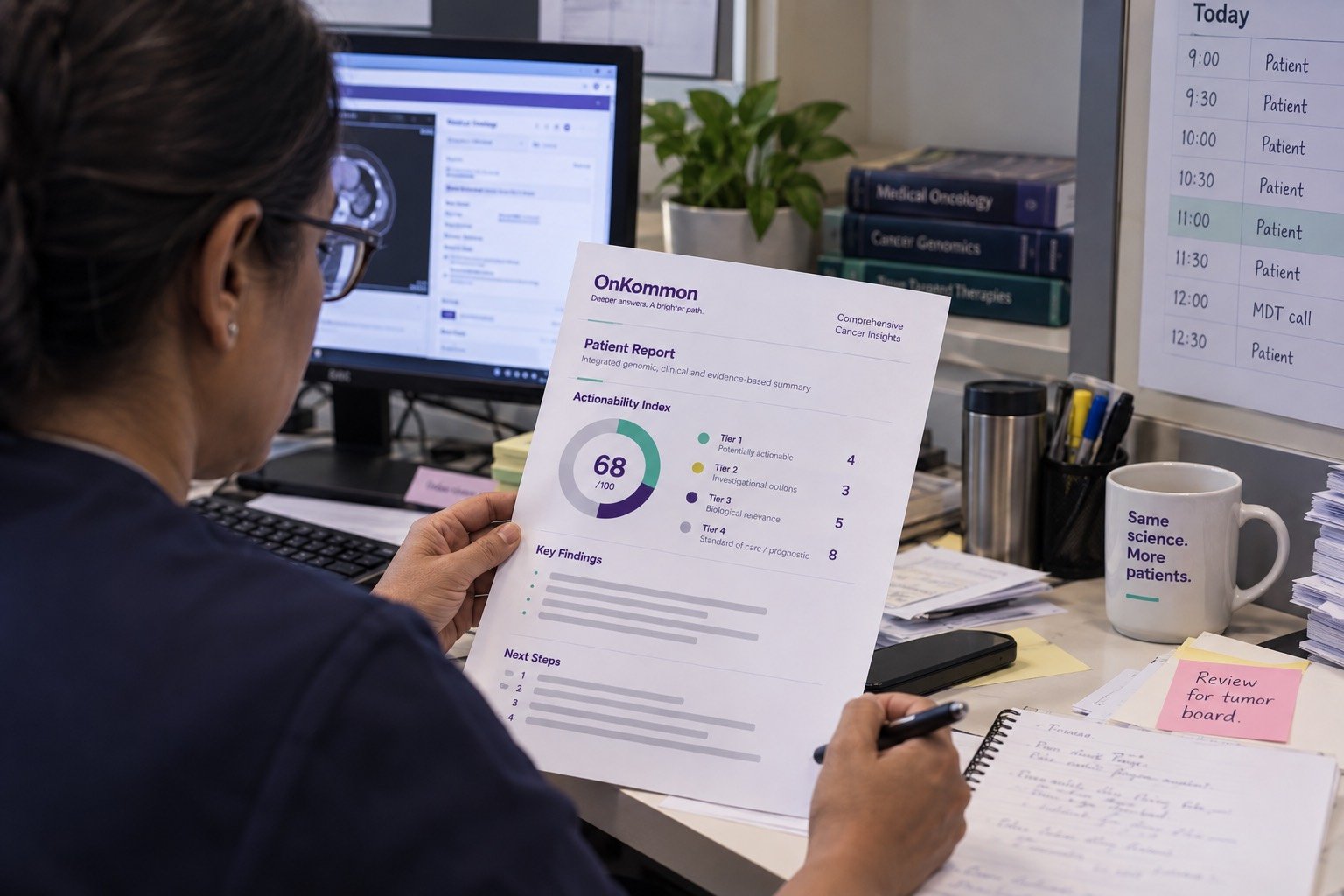
Every report opens with a one-page Chief Oncologist Summary built to be read in under a minute: Actionability Index, recommended first-line direction, explicit contraindications, and urgent flags.
Beneath it sits the full evidence, with variants tiered against AMP/ASCO/CAP, ESCAT and OncoKB, and a concordance view showing where frameworks agree.
With the rationale and evidence tier for each.
What this tumour will resist, stated plainly.
For the exact molecular profile.
For the Indian context.
To dose safely and avoid severe adverse reactions.
Serial ctDNA and MRD escalate findings back to you.
Software informs. A clinician decides.
Every clinically consequential statement is authored and signed by a licensed molecular tumour board through KPCIRC. Our engine annotates, matches and models. It does not diagnose or prescribe, and it never has the final word.
That is deliberate. It gives you a defensible, human-authored decision and a named clinical partner to discuss it with.
We advise on the right tier for your question.
Home or in-clinic phlebotomy, or retrieval of an existing block.
Accredited sequencing, then interpretation.
The board reviews, authors and signs.
You can request a board discussion or second opinion.
Through KPCIRC you can request a molecular tumour board discussion of a specific case, on a paid basis.
The same authority that signs our reports, available directly when a case is complex.
With appropriate consent, ordering can contribute de-identified data to research that improves interpretation for the next patient. Participation is optional.
Accreditation and methods
Sequencing and variant calling are performed by an accredited laboratory partner (NABL/ISO 15189, CAP and CLIA accredited) following ACMG/AMP/ASCO/CAP guidelines, using a CE-IVD certified variant database for classification and reporting.
The OnKommon engine adds biomarker matching, modelling and the intelligence layers, and is provided for research and decision-support use. It does not make a diagnosis. Every report discloses panel scope, per-gene coverage, tumour fraction and limitations.
What the laboratory is accredited to
Each standard certifies something different, so they are listed with what they actually cover rather than as a row of logos.
NABL
ISO 15189
National Accreditation Board for Testing and Calibration Laboratories, the Indian accreditation for medical testing laboratories, assessed against ISO 15189.
CAP
College of American Pathologists
Accreditation covering laboratory quality management, proficiency testing and inspection on a two-year cycle.
CLIA
Clinical Laboratory Improvement Amendments
The United States standard for laboratory testing on human samples.
ISO 15189
Medical laboratory quality
The international standard for quality and competence in medical laboratories.
ISO 9001
Quality management
Quality management systems across the wider operation, not only the bench.
CE-IVD
Certified variant database
Variant classification and reporting run against a CE-marked in-vitro diagnostic database.
Sequencing and variant calling are performed by our accredited laboratory partner. Accreditation covers the laboratory work: the OnKommon interpretation engine is separately provided for research and decision-support use, and clinical authority rests with KPCIRC.
Research and evidence
Comprehensive profiling reviewed by a molecular tumour board rests on a substantial peer-reviewed evidence base.
Tumour-board-guided matched therapy
Across 715 advanced-cancer patients, closer matching between therapy and molecular profile on board advice was associated with improved response and survival.
Kato S, et al. Nature Communications, 2020.
Liquid-biopsy profiling is guideline-supported
NCCN and ESMO recommend ctDNA profiling as an alternative or complement to tissue. ASCO recommends blood cfDNA for comprehensive profiling in advanced breast cancer.
Review, Cancers, 2022.
Plasma genotyping increases matched therapy
Adding plasma ctDNA testing to tissue in advanced lung cancer increased detection of targetable alterations and the number of patients on matched therapy.
Aggarwal C, et al. JAMA Oncology, 2019.
These independent, peer-reviewed studies describe the class of technology we use. They are shared for education. They are not results for any individual and not a promise of benefit.
Being clear about our limits
| Term | What it means |
|---|---|
| MTB | Molecular tumour board, the licensed panel that signs the report. |
| CGP | Comprehensive genomic profiling, reading many cancer genes in one test. |
| ESCAT | The ESMO scale for how ready a molecular target is to guide treatment. |
| OncoKB levels | A scale grading therapeutic actionability by level of evidence. |
| AMP/ASCO/CAP tiers | The framework grading clinical significance of somatic variants. |
| MRD | Molecular residual disease, microscopic disease left after treatment. |
Take the next step
A no-obligation conversation with our care team, arranged through KPCIRC.
Book a consultationCommission your decision report and a dedicated clinical team.
Explore Blueprint CareSignal replies to your first question within four hours, at no cost.
Start with Signal