
In exclusive clinical partnership with KPCIRC
OnKommon

Platform · where we are headed

Pipeline

Six research programmes, each marked against the same six readiness stages, with what we are doing now and what would have to be true before it went further. None is above stage two.

Nothing on this page is a clinical service, and nothing on it informs any report we produce today.

Research today, care tomorrow

A pipeline page that reads like a product page is a warning sign.

Most of what follows will take years. Some of it will not work, and we will say so here when that becomes clear rather than quietly removing the entry.

The scale used below

How to read a readiness stage

Every programme below is marked against the same six stages. The distinction between stages four and five is the one most often blurred in this industry, and it is the one that actually matters.

S1
Discovery

The idea exists and early data supports it. Nothing is being claimed.

S2
Preclinical

Working in models and on retrospective data. No prospective human evidence yet.

S3
Analytical validation

Does the measurement itself work? Reproducible, accurate, robust across conditions.

S4
Clinical validation

Does the measurement predict something real in patients? A different and harder question.

S5
Clinical utility

Does acting on it change outcomes? The question most often skipped, and the one that matters.

S6
Regulatory and deployment

Registered, and available as a service under clinical governance.

The programmes

Six programmes, and where each one honestly sits

None is above stage two. That is what an early pipeline looks like, and stating it is more useful to you than a diagram implying otherwise.

Programme 01

Histocommon AI

Reading the standard tumour slide with AI to predict molecular features.

Why it matters
Every cancer patient already has an H&E stained slide. If more signal can be extracted from a resource that already exists, that is a genuine equity argument as well as a scientific one: it does not require anyone to afford another test.
What we are doing now
Model development on retrospective slide and molecular pairs, with attention to whether performance holds across scanners, laboratories and staining protocols, which is where computational pathology most often fails to generalise.
What would have to be true to go further
Prospective validation in Indian laboratories, on Indian scanners, before any claim could be made. Performance demonstrated on one institution’s slides is not evidence that it works on another’s.
What it is not
Not a replacement for molecular testing, and not a diagnostic aid available today.
Programme 02

Digital Twin Oncology

A computational model of an individual’s cancer, in which candidate therapies can be simulated before they are given.

Why it matters
It is the fullest expression of exploring every option to find the right one faster, and it is our north star. It is also the programme furthest from clinical reality, and we would rather say that plainly than let the phrase do work it has not earned.
What we are doing now
Integrating genomic, clonal, immune and clinical layers into a single model, and testing whether it can retrospectively predict what actually happened to patients whose outcomes we already know.
What would have to be true to go further
A great deal. Retrospective predictive accuracy, then prospective validation, then evidence that acting on a simulation improves outcomes over acting without it. Each of those is years of work, and the third is the hardest.
What it is not
Not a service, not available to patients, and not something any current OnKommon report uses.
Programme 03

Dendritic Cell Vaccine Screening

Screening to identify the tumour-specific targets most likely to provoke an effective immune response.

Why it matters
Personalised neoantigen immunotherapy depends on picking the right targets from many candidates. Target selection is the bottleneck, not manufacture.
What we are doing now
Computational prediction of which neoantigens are genuinely presented and immunogenic, benchmarked against experimental readouts.
What would have to be true to go further
Experimental confirmation that predicted targets actually provoke a response, and then a clinical programme with the regulatory pathway that implies.
What it is not
Not a treatment we offer. We are working on the selection problem, not on giving anyone a vaccine.
Programme 04

In Vivo Avatars

Fruit-fly models engineered to carry a patient’s tumour alterations, used to test how drug combinations behave against that specific genetic makeup.

Why it matters
Computational prediction and living biology fail in different ways. A fast, cheap, scalable functional model is a useful check on a prediction, precisely because it can disagree with it.
What we are doing now
Model construction and combination screening, with attention to how well fly biology actually transfers to human cancer, which is the obvious objection and the right one.
What would have to be true to go further
Demonstration that avatar results predict human response, which is the whole question and is not yet answered.
What it is not
Not a way to test your own treatment options. Nothing from this programme informs any clinical report.
Programme 05

Spatial Immune Atlas

Mapping not just which cells are present in a tumour but where they sit relative to each other.

Why it matters
Whether an immune cell is inside a tumour or excluded at its edge changes what its presence means entirely. Bulk measurements average that away, and the average can be actively misleading.
What we are doing now
Spatial multi-omic profiling on research cohorts, building the reference maps that any future clinical use would need.
What would have to be true to go further
A demonstration that spatial context predicts response better than existing markers, and a workflow affordable enough to be used routinely.
What it is not
Not part of any current report, and not a test that can be ordered.
Programme 06

Federated Evidence Network

Infrastructure that lets the engine learn across many institutions without patient data leaving any of them.

Why it matters
Interpretation improves with scale, and the scale that matters is unreachable if every institution must first agree to move its data. Sending the model to the data instead removes the objection that stops most collaborations.
What we are doing now
Building and testing the infrastructure with early partner sites, including the unglamorous parts: harmonisation, governance and audit.
What would have to be true to go further
Partner institutions willing to participate, and a demonstration that federated learning here produces results comparable to centralised analysis.
What it is not
Not currently operating across external sites. This is the programme where we most want partners.
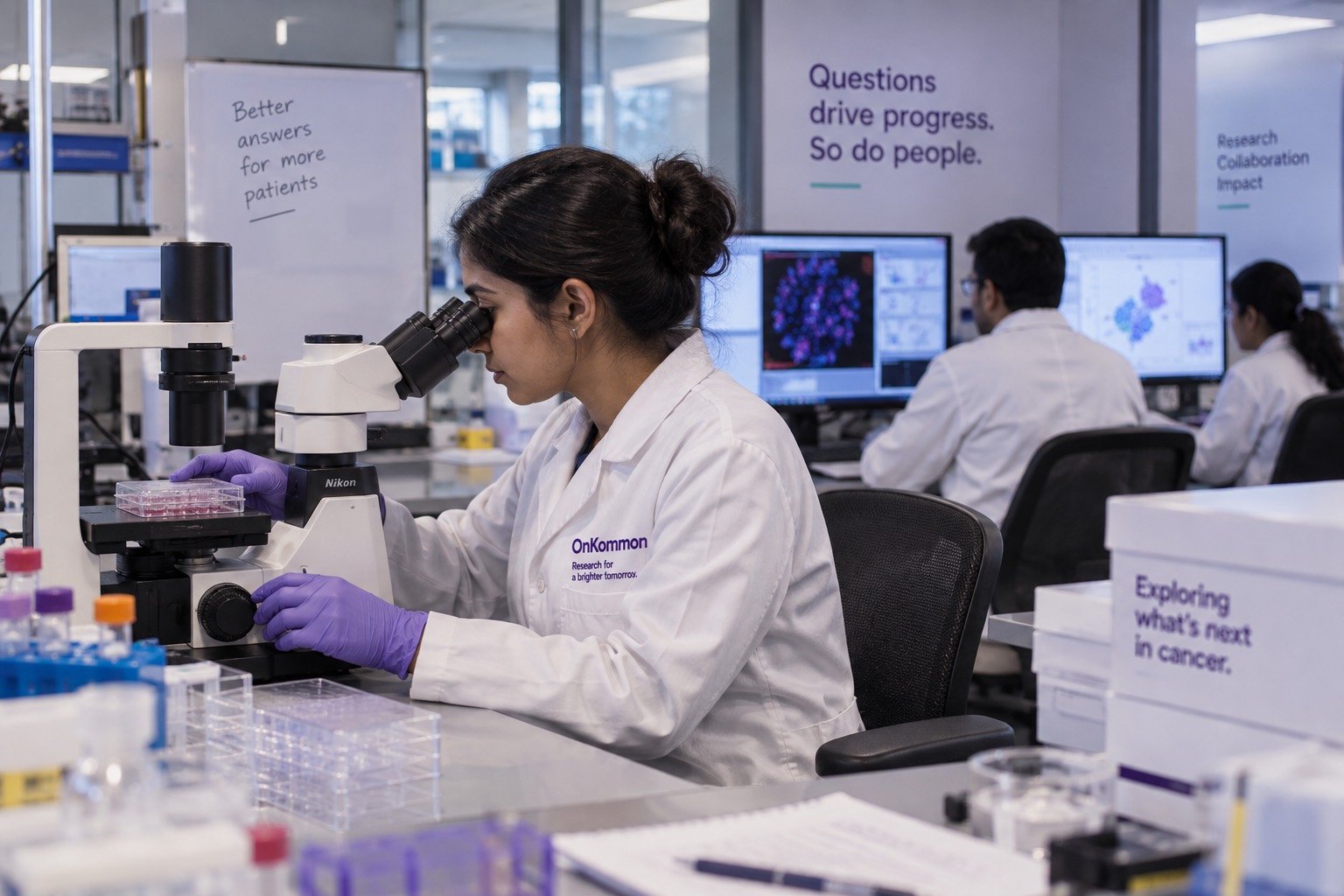
A researcher at work in the OnKommon laboratory, with analysis on screens behind them.
Active research. None of the pipeline is a clinical service today.

How it connects

Every product is a step toward the twin

  1. ProfileBlueprint Care and Signature

    Read the whole tumour today.

  2. MonitorSentinel and Clear

    Follow it through time.

  3. ModelAvatars and spatial atlases

    Test and map it functionally.

  4. SimulateThe Digital Twin

    Bring it together, and explore every option.

The services are not a distraction from the research. They are how the research gets the longitudinal data it needs, and how it stays anchored to decisions real clinicians actually have to make.

Collaborate on a programmeHow we are held to account

Take the next step

Three ways forward. Pick the one that fits today.

01

Book a free consultation

A no-obligation conversation with our care team, arranged through KPCIRC.

Book a consultation
02

Begin Blueprint Care

Commission your decision report and a dedicated clinical team.

Explore Blueprint Care
03

Ask on WhatsApp, free

Signal replies to your first question within four hours, at no cost.

Start with Signal