Book a free consultation
A no-obligation conversation with our care team, arranged through KPCIRC.
Book a consultation
If this is where you are
Newly diagnosedReports arriving, no plan yetAlready tested elsewhereYou have results you cannot readOn treatment nowYou want to know it is workingOr
Finished treatmentWatching for anything left behindWorried about familyInherited risk, and relativesWanting a second opinionA decision you are unsure aboutDecide
Blueprint CareThe flagship decision report and a dedicated clinical teamSignalOne free question answered on WhatsApp within four hoursNavigationRecords you already have, turned into a clarity timelineDecipherInterpretation of sequencing already done elsewhereTest: solid tumour
All Signature testsEvery panel compared, side by sideSignature STb33 genes from a blood drawSignature STb O118 genes from blood, including fusionsSignature STb O+523 genes, with TMB, MSI and pharmacogenomicsSignature STt OComprehensive profiling from a tissue blockTest: blood cancer
Signature BML+Myeloid, 600+ genes, with MDS and MPN overlapSignature BLL+Lymphoid, 600+ genes, with Philadelphia-like detectionSignature CustomDesigned around one question when neither family fitsMonitor
SentinelSerial monitoring while treatment is runningSentinel SolidctDNA monitoring for solid tumoursClearMolecular residual disease surveillanceClear SolidTumour-informed surveillance for solid tumoursClear BloodResidual disease surveillance after blood cancer treatmentProtect
HeritageInherited risk, assessed properlyHeritage CoreA broad inherited-risk assessmentHeritage AdhocFocused testing for named relativesCancer DictionaryWhat is discussed in your specific cancerReference
Cancer DictionaryOne structured entry per cancer typeBiomarker LibraryOne page per marker, in plain languagePatient ResourcesGlossary, guides and how to use themWatch, read and ask
Video LibraryShort explainers, captioned and translatedJourneysFour composites showing how a decision gets madeCase studiesNine situations and the test that fits eachFAQThe questions we are asked mostKnowledge · learning hub
A calm place to understand what is happening, written to reduce fear with understanding.
Reduce fear with understanding. Never alarm.
Four pillars: the Cancer Dictionary, the Biomarker Library, the Video Library and the FAQ. The first two have grown into sections of their own.
Written for a sixth-grade reading level, without dumbing down.
We avoid numbers presented without context.
Every article ends with somewhere useful to go.
Now a section of its own
One structured entry per cancer type, each answering the same eight questions in the same order.
The dictionary has outgrown this page. It now holds a full entry for each of 37 cancer types: the governing idea, the major disease categories, what is discussed molecularly, when that information matters across the course of the disease, and the questions worth raising with a treating team.
Open the Cancer DictionaryBiomarker Library
These come up in almost every entry, so they are collected here rather than repeated. Each dictionary entry also carries its own glossary for terms specific to that cancer.
Also a section of its own
One page-length entry per marker: what it actually is, why it gets discussed, how it is measured, and what a result does not tell you.
Markers are the part of a report people most often try to look up and most often misread, because the same marker can mean different things in different cancers and be measured by methods that are not interchangeable. The library says so, marker by marker, and links each one to the cancers where it comes up.
| Marker | Why people look it up |
|---|---|
| EGFR | A common driver in lung cancer, with several generations of matched therapy. |
| ALK, ROS1, RET, NTRK | Fusion drivers. A panel that reads only point mutations will miss them. |
| KRAS | The most frequent driver in several cancers. The specific variant matters. |
| BRAF | V600E specifically. Non-V600E variants do not carry the same evidence. |
| HER2 (ERBB2) | Amplification and mutation are two different findings. |
| BRCA1 and BRCA2 | Relevant both as a tumour finding and as inherited risk. Not the same test. |
| MMR and MSI | One of the clearest tumour-agnostic markers, and the main route to finding Lynch syndrome. |
| TMB | Panel size and method both change the number, so values are not comparable across assays. |
| ctDNA | A “not detected” result may mean the tumour sheds little DNA, not that it is absent. |
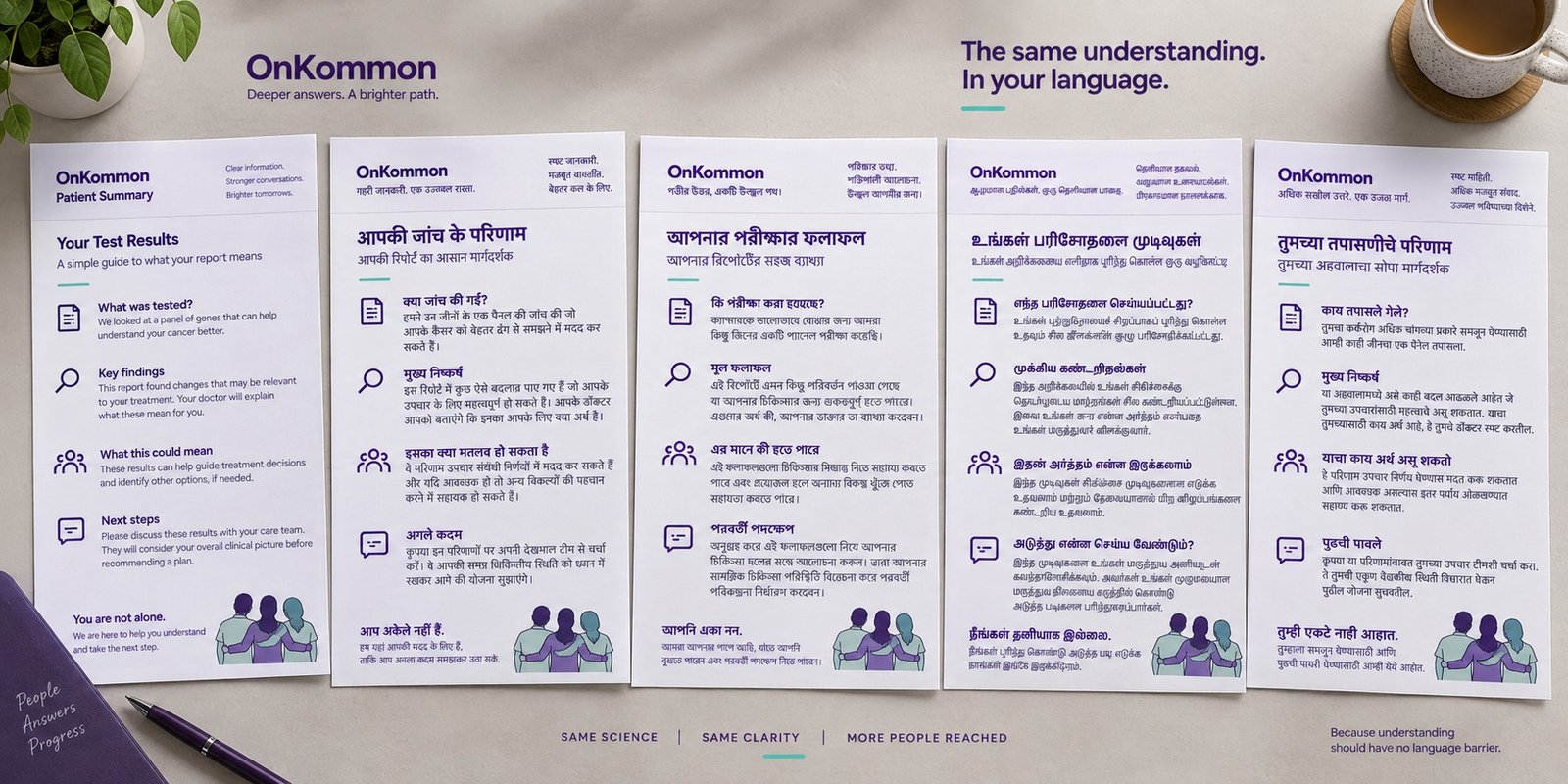
Every article and video is translated into regional languages, because understanding your own diagnosis should not depend on reading technical English.
Take the next step
A no-obligation conversation with our care team, arranged through KPCIRC.
Book a consultationCommission your decision report and a dedicated clinical team.
Explore Blueprint CareSignal replies to your first question within four hours, at no cost.
Start with Signal