CloneTrace™clonal architecture
Which mutations are founder events present in every cancer cell, and which are later branches, so therapy targets the trunk rather than a twig.

If this is where you are
Newly diagnosedReports arriving, no plan yetAlready tested elsewhereYou have results you cannot readOn treatment nowYou want to know it is workingOr
Finished treatmentWatching for anything left behindWorried about familyInherited risk, and relativesWanting a second opinionA decision you are unsure aboutDecide
Blueprint CareThe flagship decision report and a dedicated clinical teamSignalOne free question answered on WhatsApp within four hoursNavigationRecords you already have, turned into a clarity timelineDecipherInterpretation of sequencing already done elsewhereTest: solid tumour
All Signature testsEvery panel compared, side by sideSignature STb33 genes from a blood drawSignature STb O118 genes from blood, including fusionsSignature STb O+523 genes, with TMB, MSI and pharmacogenomicsSignature STt OComprehensive profiling from a tissue blockTest: blood cancer
Signature BML+Myeloid, 600+ genes, with MDS and MPN overlapSignature BLL+Lymphoid, 600+ genes, with Philadelphia-like detectionSignature CustomDesigned around one question when neither family fitsMonitor
SentinelSerial monitoring while treatment is runningSentinel SolidctDNA monitoring for solid tumoursClearMolecular residual disease surveillanceClear SolidTumour-informed surveillance for solid tumoursClear BloodResidual disease surveillance after blood cancer treatmentProtect
HeritageInherited risk, assessed properlyHeritage CoreA broad inherited-risk assessmentHeritage AdhocFocused testing for named relativesCancer DictionaryWhat is discussed in your specific cancerReference
Cancer DictionaryOne structured entry per cancer typeBiomarker LibraryOne page per marker, in plain languagePatient ResourcesGlossary, guides and how to use themWatch, read and ask
Video LibraryShort explainers, captioned and translatedJourneysFour composites showing how a decision gets madeCase studiesNine situations and the test that fits eachFAQThe questions we are asked mostPillar 1 · The flagship
Your decision report, executed by a dedicated clinical team. Not a variant list, but the decision, the reasoning, the access routes and the people to carry it out.
Blueprint Care takes the complete molecular picture of your cancer and turns it into a ranked, sign-out-ready treatment plan. Then it puts a named clinical team beside you to act on it, monitor it, and adjust as things change.
It is fed by a Signature molecular test, or by your existing data through Decipher.
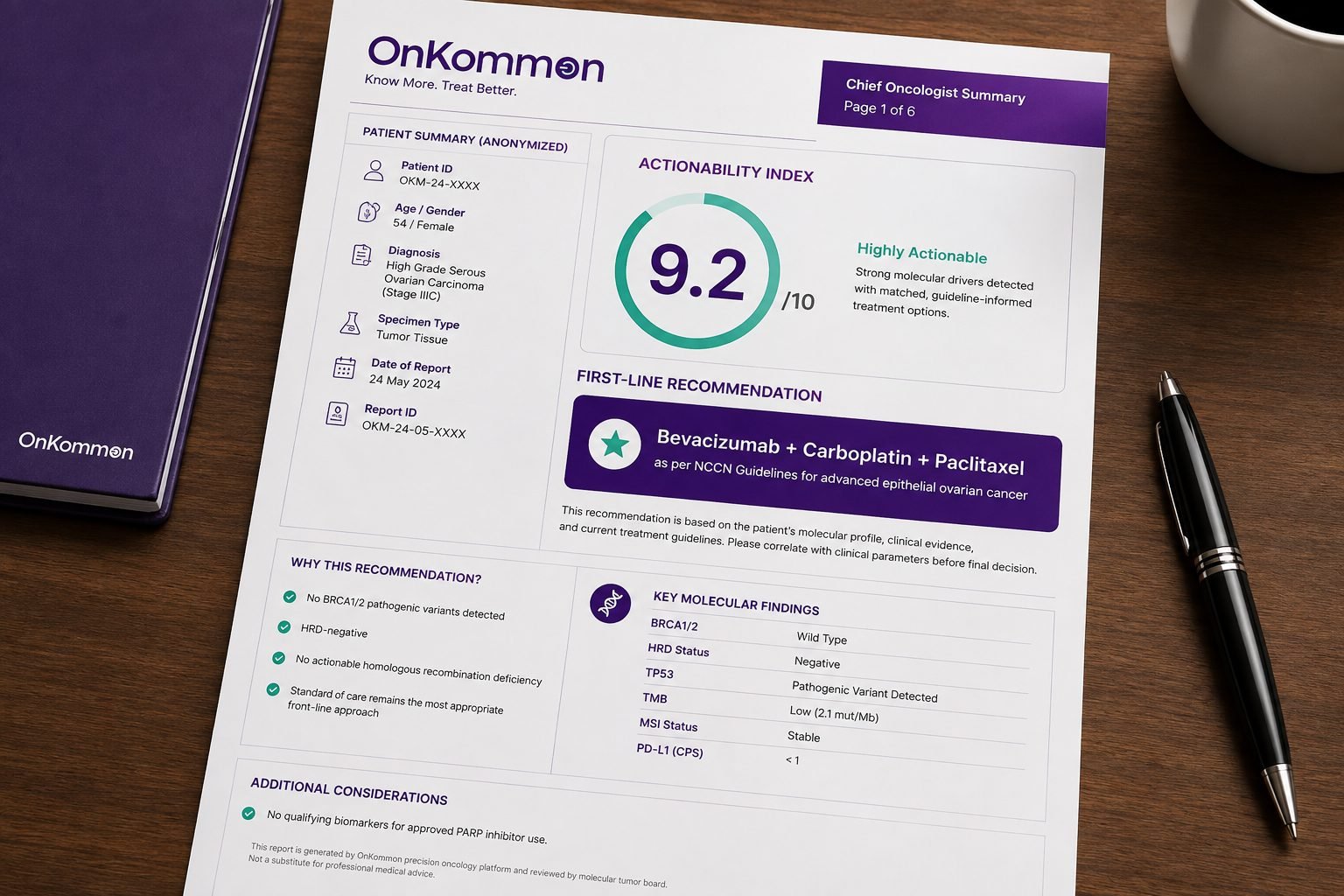
A sequencing report says what mutations are present. Blueprint Care says what to do about them.
The same eleven decisions, every time, so nothing important is left implicit.
| # | What we mark down | Why it matters |
|---|---|---|
| 01 | First-line therapy | The best-supported treatment to start, with a confidence rationale. |
| 02 | What to avoid | Therapies this tumour will resist, so time and money are not wasted. |
| 03 | Matched trials | Recruiting studies that fit this exact molecular profile. |
| 04 | Biosimilar options | Clinically equivalent, lower-cost alternatives available in India. |
| 05 | On-label vs off-label | Where a therapy is approved, and where it would be off-label or via trial. |
| 06 | Resistance plan | How the tumour may escape, and the serial testing to catch it. |
| 07 | Access and cost | Assistance programmes, schemes and a realistic out-of-pocket picture. |
| 08 | Hereditary flags | Signals that inherited risk testing is warranted for you and relatives. |
| 09 | Drug safety (PGx) | How you may metabolise key drugs, to dose safely and avoid harm. |
| 10 | Prognostic context | What the biology suggests, stated honestly and without false certainty. |
| 11 | Actionability Index | A single readout of how targetable this tumour is. |
Six section groups
The report moves from what to do in the next sixty seconds through to the deepest biology. It opens with a one-page Chief Oncologist Summary: the Actionability Index, what to start, what to avoid, and urgent flags.
| Group | What it covers |
|---|---|
| Summary and actions | The clinical bottom line and a visual treatment roadmap. |
| Test provenance | What was sequenced, panel scope, limitations, pipeline traceability. |
| Genomic landscape | TMB, MSI, mutational signatures and the copy-number picture. |
| Clinical variants | Every driver alteration, its evidence tier and its consequence. |
| Intelligence layers | Subtype, clonal architecture, immune evasion, synergy, pathway biology. |
| Therapy and access | Therapy matrix, immunotherapy index, trials, resistance forecast, India access. |
Chief Oncologist Summary
Page one is built to be read in under a minute: the Actionability Index, the recommended first-line direction, explicit contraindications and any urgent flags. Everything beneath it is the evidence for that page.
Layer 01 of 06
Test Provenance
A result without its quality record is not interpretable. This layer states the sample, the panel scope, the per-gene coverage, the tumour fraction and the limit of detection, so a negative finding can be read for what it is worth.
Layer 02 of 06
Genomic Landscape
Single variants read in isolation miss the shape of the disease. This layer carries mutational burden, microsatellite status, copy number events and mutational signatures, so the individual findings are read in context.
Layer 03 of 06
Clinical Variants
Every alteration is graded against AMP/ASCO/CAP, ESCAT and OncoKB together. Where those frameworks disagree, the report shows the disagreement rather than quietly picking the most favourable one.
Layer 04 of 06
Intelligence Layers
Public databases say what a variant is. They cannot say how a tumour will evolve, whether the immune system can see it, or which combination is worth the toxicity. Six layers add that, each stating what it needs and what it cannot do.
Layer 05 of 06
Therapy and Access
A recommendation nobody can reach is not a recommendation. This layer maps each option to clinically equivalent biosimilars, patient assistance programmes and government schemes available in India, and names who is chasing what.
Layer 06 of 06
Select a layer to open it. Arrow keys move between layers.
Beyond public databases
Public annotation tells you what a variant is. These layers tell you what to do about it.
Which mutations are founder events present in every cancer cell, and which are later branches, so therapy targets the trunk rather than a twig.
Which drug combinations offer real added benefit versus overlapping toxicity, scored as a net-benefit index.
The tumour’s biological subtype, which sharpens both treatment choice and prognosis.
Whether the immune system can see the tumour, combining antigenicity with intact antigen presentation, to predict immunotherapy response.
Recruiting trials that fit this profile, plus a real-world picture of similar patients.
Biosimilars, assistance programmes and the realistic cost pathway in India.
We choose the right starting test, or use your existing data.
A blood draw at home or in clinic, or your existing tissue block.
An accredited laboratory reads the DNA with transparent quality control.
Annotation, matching, and the six intelligence layers.
A molecular tumour board authors and signs the plan.
The full document plus a plain-language version in your language.
Someone walks you and your family through results and access.
Sentinel, Clear and Heritage extend the same care.
Meet your navigator
Two-minute piece with a real OnKommon navigator, in the first person, on what they actually do in a week. The most reassuring asset on the site, so it should feel like meeting a person.
Handheld, on location. One camera, natural light, lapel mic.
Must be in frame
Must not be
Before launch: Save the supplied photograph as assets/img/navigator-priya.jpg and rebuild. The brief above is replaced automatically once the file is present.
A simple draw. No surgery, repeatable, ideal when tissue is hard to get. See the blood tiers.
If you have a tumour block, Signature STt O profiles it comprehensively.
Already tested elsewhere? Decipher builds the full report from your results, with no resequencing.
| Blueprint Care | A standard report | |
|---|---|---|
| Output | Ranked, signed decision and plan | A variant list |
| Interpretation | Six proprietary intelligence layers | Left to the reader |
| Accountability | KPCIRC licensed sign-out | Often unclear |
| Trials and biosimilars | Matched and marked down | Rarely included |
| India cost pathway | Assistance programmes and schemes surfaced | Not addressed |
| Language | Plus a regional-language summary | Technical English |
| Afterwards | A navigator and continuous coordination | You are on your own |
Precision oncology is only real if you can reach it. We pair expensive targeted therapies with CDSCO-approved biosimilars where clinically equivalent, file the paperwork for assistance programmes, and map state and private schemes.
Research and evidence
Comprehensive profiling reviewed by a molecular tumour board has been studied in thousands of patients.
Tumour board review improved outcomes
In 715 patients with advanced cancer, closer matching between therapy and molecular profile on board advice gave better response and longer survival.
Kato S, et al. Nature Communications, 2020.
Higher matching, better results
In treatment-refractory cancers, patients whose therapy targeted more of their specific alterations had significantly longer progression-free and overall survival.
Sicklick JK, et al. (I-PREDICT) Nature Medicine, 2019.
What the overall evidence shows
A systematic review found board review appears to improve outcomes, while calling for more prospective randomized trials.
Systematic review, JCO Precision Oncology, 2021.
These independent, peer-reviewed studies describe the class of technology we use. They are shared for education. They are not results for any individual and not a promise of benefit.
Being clear about our limits
| Term | What it means |
|---|---|
| MTB | Molecular tumour board, the specialist panel that signs your plan. |
| CGP | Comprehensive genomic profiling, reading many cancer genes in one test. |
| TMB | Tumour mutational burden, how many mutations a tumour carries. |
| MSI / MMR | Signals of faulty DNA repair that often predict immunotherapy response. |
| ctDNA | Circulating tumour DNA, tumour fragments a blood test can read. |
| Actionable | A finding with a matched drug, a trial, or a clear management step. |
Blueprint Care and the Signature tests that feed it is a genomic (DNA-based) test for use by qualified healthcare professionals. It supports clinical judgement, it does not replace it, and it must be read alongside your full clinical history and applicable guidelines.
Regulatory status (India). Registration of our genomic tests as in-vitro diagnostic (IVD) medical devices with CDSCO is in progress, with the IVD class pending. Sequencing and variant calling are done by an accredited laboratory partner holding NABL (ISO 15189), CAP and CLIA accreditation, following ACMG/AMP/ASCO/CAP guidelines and a CE-IVD certified variant database. The OnKommon interpretation engine is provided for research and decision-support use. Marketing follows the Drugs and Magic Remedies (Objectionable Advertisements) Act, 1954.
Take the next step
A no-obligation conversation with our care team, arranged through KPCIRC.
Book a consultationCommission your decision report and a dedicated clinical team.
Explore Blueprint CareSignal replies to your first question within four hours, at no cost.
Start with Signal