
In exclusive clinical partnership with KPCIRC
OnKommon

Platform · the engine

The Engine

How raw genomic signal becomes a decision a clinician can sign: what goes in, what comes out, what each layer needs, and where the engine can be wrong.

The OnKommon Precision Intelligence Platform

Turning raw signal into a decision a clinician can sign

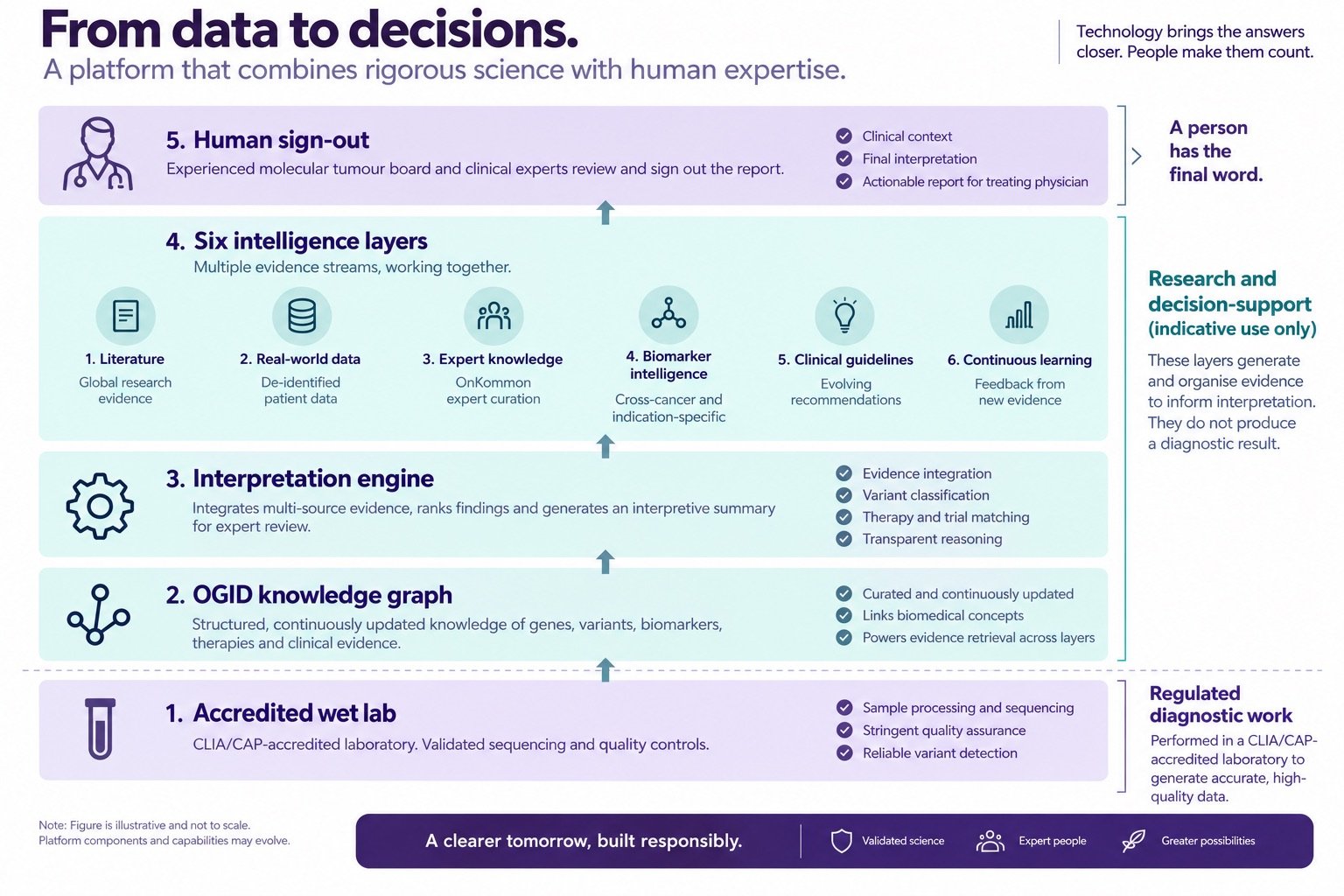
Not a single algorithm, but a stack: an accredited generation layer, a curated knowledge substrate, a core interpretation engine, and six intelligence layers, with a licensed human holding the last word.

Every output is traceable, versioned, and handed to a human for the final word.

End to end

The three-stage spine

  1. GenerateAccredited sequencing

    Laboratory partners sequence the tumour from blood or tissue, with transparent quality control and per-gene coverage.

  2. InterpretThe OnKommon engine

    It annotates every alteration, matches therapies and trials, and applies the six layers.

  3. Sign outKPCIRC tumour board

    Licensed clinicians review, add judgement, author the narrative and sign.

What goes in

  • Sequencing output from an accredited laboratory, with its quality metrics
  • Sample provenance: blood or tissue, when taken, tumour fraction
  • The clinical context: cancer type, stage, histology and prior treatment
  • Immunohistochemistry results where they exist, such as PD-L1 or HER2
  • Any prior genomic testing, so results can be compared rather than replaced

What comes out

  • A one-page Chief Oncologist Summary, readable in under a minute
  • Ranked therapy options, each with its evidence tier and the reasoning behind it
  • Explicit contraindications, stated as plainly as the recommendations
  • Matched clinical trials, filtered by molecular profile and prior therapy
  • Biosimilar, assistance programme and scheme mapping for the Indian context
  • The full quality record, including what the assay could not have detected
The platform stack as horizontal bands: accredited sequencing, the OGID knowledge graph, the interpretation engine, six intelligence layers, and human sign-out on top, with the regulated and research-use portions marked.
The regulated diagnostic work and the research-use engine are marked separately, because the distinction is legally significant.

The core

The engine and its knowledge graph

At the core sits the OnKommon Interpretation Engine, working against OGID, our curated and versioned knowledge graph. OGID harmonises the leading evidence standards into one auditable framework, so every call is reproducible and every report states which knowledge version produced it.

Annotation and oncogenicity

Each variant classified for biological effect and cancer relevance.

Evidence tiering

Clinical significance graded against international frameworks.

Biomarker matching

Actionable alterations linked to therapies and recruiting studies.

Quality aware

Depth, tumour fraction and coverage carried through, so results are read in context.

Beyond annotation

The six intelligence layers

Public databases say what a variant is. They cannot say how a tumour will evolve, whether the immune system can see it, or which combination is worth the toxicity. Each layer below states what it needs, and what it cannot do.

CloneTrace™clonal architecture and forecasting

Reconstructs which mutations are founder events present in every cancer cell versus later subclonal branches, and forecasts likely evolutionary paths. Targeting the trunk rather than a twig is one of the most important ideas in durable treatment.

Needs
Variant allele frequencies, copy number and tumour purity. Low tumour fraction degrades the reconstruction, and the report says so when it does.
Cannot
Cannot see subclones present below the detection limit of the assay, and cannot distinguish clonal structure reliably from a single low-purity sample.

SynerGx™combination synergy

Scores rational drug combinations for genuine added benefit against overlapping toxicity, as a net-benefit index, so combinations are proposed on evidence rather than on the fact that two drugs both look reasonable alone.

Needs
The pathway context, the alterations present, and the toxicity profile of each agent.
Cannot
Cannot predict tolerability for an individual, and does not account for comorbidity, organ function or what a person is willing to accept.

PhenoMap™molecular subtype

Places the tumour into its biological subtype, sharpening both treatment selection and prognostic context beyond single-gene findings.

Needs
Sufficient panel breadth. Subtype assignment from a narrow panel is unreliable and is withheld rather than reported with false confidence.
Cannot
Cannot assign a subtype where the reference classification does not exist for that cancer, which is still the case in many diseases.

ImmunoLens™immune evasion and response

Combines antigenicity, how visible the tumour is, with the integrity of the antigen-presentation machinery, whether it can hide, to estimate the real chance immunotherapy will work.

Needs
TMB, HLA typing, antigen presentation pathway status and, where available, PD-L1 from immunohistochemistry.
Cannot
Cannot see the tumour microenvironment from sequence alone. Whether immune cells are present and where they sit is a spatial question this layer does not answer.

TrialGraph™trials and patient-like-me matching

Matches the exact profile to recruiting trials, and situates the case against a real-world cohort of similar patients.

Needs
An accurate treatment history. Prior therapy determines eligibility at least as often as the molecular profile does.
Cannot
Cannot guarantee a site is recruiting today, that the patient will be found eligible on screening, or that travel and cost make participation feasible.

AccessMatch™biosimilars, access and economics

Maps each recommended therapy to clinically equivalent biosimilars, assistance programmes and government schemes available in India.

Needs
Current availability and programme eligibility data, which changes frequently and is refreshed rather than assumed.
Cannot
Cannot guarantee a drug is in stock, that an application will succeed, or that a scheme still operates in a particular state.

One number, honestly framed

The Actionability Index

One number for how targetable this cancer is.

A single 0 to 100 readout of how many high-quality, matched therapeutic options the biology supports. It is fast orientation for a clinician with four minutes between patients, never a substitute for the detailed evidence beneath it, which every report shows in full.

A low index is information, not a verdict. It says this tumour has few molecularly matched options on current evidence, which is exactly when trials, access support and a tumour board discussion matter most. We would rather report a low number accurately than inflate it to seem useful.

Quality, on the page

What every report shows about itself

A result without its quality record is not interpretable. These six things appear on every report, in every case, including the ones where they are unflattering.

What is statedWhy it is there
Panel scopeWhich genes were assessed, and for which classes of alteration.
Per-gene coverageHow deeply each gene was actually read, not the average across the panel.
Tumour fractionHow much of the sample was tumour. It governs how much confidence a negative result deserves.
Limit of detectionThe lowest variant frequency the run could have detected.
Knowledge base versionThe exact OGID version that produced the interpretation, so the call can be reproduced later.
What was not assessedStated explicitly, because the most dangerous line in a report is the one that is missing.

Evidence tiers and frameworks

We do not invent our own significance scale. Where frameworks disagree, we show the disagreement rather than hide it.

FrameworkWhat it grades
AMP/ASCO/CAP tiersClinical significance of somatic variants, Tier I to IV.
ESCATHow ready a molecular target is to guide treatment.
OncoKB levelsTherapeutic actionability by level of evidence.

Data, security and standards

  • Interoperability. Structured reporting aligned to FHIR and mCODE, so results integrate cleanly with clinical systems.
  • Security. Encryption in transit and at rest, access controls, audit trails.
  • Compliance. Data handled under India’s Digital Personal Data Protection Act, 2023, with explicit consent for any research use.

Stated by us, not discovered by you

Where the engine can be wrong

Known limits we design around

Every one of these is a place where an interpretation engine can mislead. We would rather name them here than have them found in a report.

  • A finding we cannot classify is reported as uncertain, not quietly omitted. Variants of uncertain significance are a real and common outcome, and calling one actionable to seem more useful would be the worst thing we could do.
  • Where AMP/ASCO/CAP, ESCAT and OncoKB disagree about a variant, the report shows the disagreement rather than picking the most favourable one.
  • Reference databases under-represent South Asian ancestry, which affects how confidently a variant of uncertain significance can be resolved for an Indian patient. We state this on the report rather than treating it as an internal problem.
  • The engine does not know what it was not given. A narrow panel, a poor sample or an incomplete treatment history all limit it, and the report says which applied.
  • Matching a therapy is not predicting a response. The engine ranks options by evidence; it does not forecast what will happen to an individual.

Human in the loop

The platform is decision-support software. It informs a clinician, who decides. Our development follows recognised software-as-a-medical-device and clinical-AI good practice: versioned models, documented validation, transparent limitations, and human authorship of every consequential output through KPCIRC.

Accreditation and standards

How the wet-lab science is held to standard

Sequencing runs on high-throughput platforms in a laboratory partner accredited to NABL (ISO 15189), CAP and CLIA. Variant calling, classification and reporting follow ACMG/AMP/ASCO/CAP guidelines using a CE-IVD certified variant database.

Accredited to recognised standards

Our laboratory partner holds Indian and international accreditation, and each standard below certifies something different. Which one matters depends on the question being asked about a result.

NABL

ISO 15189

National Accreditation Board for Testing and Calibration Laboratories, the Indian accreditation for medical testing laboratories, assessed against ISO 15189.

CAP

College of American Pathologists

Accreditation covering laboratory quality management, proficiency testing and inspection on a two-year cycle.

CLIA

Clinical Laboratory Improvement Amendments

The United States standard for laboratory testing on human samples.

ISO 15189

Medical laboratory quality

The international standard for quality and competence in medical laboratories.

ISO 9001

Quality management

Quality management systems across the wider operation, not only the bench.

CE-IVD

Certified variant database

Variant classification and reporting run against a CE-marked in-vitro diagnostic database.

Sequencing and variant calling are performed by our accredited laboratory partner. Accreditation covers the laboratory work: the OnKommon interpretation engine is separately provided for research and decision-support use, and clinical authority rests with KPCIRC.

What we DO

  • Run accredited sequencing and variant calling
  • Grade every variant against three international frameworks
  • Version the knowledge base and state the version on every report
  • Report per-gene coverage, tumour fraction and what was not assessed
  • Keep a licensed human as the final authority

What we DON’T do

  • Let software diagnose or prescribe
  • Report a result without disclosing coverage, tumour fraction and limits
  • Claim regulatory approvals we do not hold
  • Present a therapy match as a prediction of response
  • Use your data for research without separate, explicit consent
Plain-language glossary (8 terms)
TermWhat it means
OPIPThe OnKommon Precision Intelligence Platform, the whole interpretation stack.
OGIDOur curated, versioned gene interpretation knowledge graph.
OncogenicityWhether a variant actually drives cancer biology.
Evidence tierHow strong the clinical evidence is for acting on a finding.
Tumour fractionHow much of a sample is actually tumour. It governs how much a negative result is worth.
Limit of detectionThe lowest level of a variant an assay could have found.
FHIR / mCODEHealthcare data standards that let results integrate with clinical systems.
SaMDSoftware as a medical device, the regulatory category for clinical software.

Take the next step

Three ways forward. Pick the one that fits today.

01

Book a free consultation

A no-obligation conversation with our care team, arranged through KPCIRC.

Book a consultation
02

Begin Blueprint Care

Commission your decision report and a dedicated clinical team.

Explore Blueprint Care
03

Ask on WhatsApp, free

Signal replies to your first question within four hours, at no cost.

Start with Signal