
In exclusive clinical partnership with KPCIRC
OnKommon

For professionals · data, collaboration and the digital twin

Research Collaboration

Five ways to work with us, what we can actually offer, the governance we will not move on, and honest timelines for each. Including where we are looking for partners right now.

If our data cannot answer your question, we will tell you at the first conversation rather than at month four.

Data, collaboration and the twin

A company with a research spine

The services fund the research. The research is why the services exist.

Our commercial work generates exactly the kind of longitudinal, consented clinicogenomic data that oncology research needs and rarely has: the same patients profiled at baseline, monitored through treatment, and followed to outcome, inside one pathway rather than stitched together across systems that were never designed to talk to each other.

Our long-term goal, a validated computational twin of an individual’s cancer, is not a product roadmap item. It is a research programme, and it will succeed or fail on evidence produced with people outside this company.

5collaboration models
2consents, care and research, always separate
0identifiable data released, under any model
1versioned knowledge base, so results reproduce

Data assets

What we can actually offer

Stated as capabilities rather than numbers, because a cohort size quoted today is wrong by next quarter and a number without provenance is worth nothing. We will give you the real figures at first contact.

Longitudinal ctDNA time series

Serial monitoring produces repeated measurements on the same patient through treatment, which is the kind of data that shows how resistance actually emerges rather than that it did.

Linked clinicogenomic records

Baseline profiling linked to treatment received and to outcome, within one care pathway rather than assembled across disconnected systems.

Indian-population genomic data

Variant frequency and clinical context in a population substantially under-represented in the reference databases everyone interprets against. This is the asset we think is most scientifically valuable and most often missing.

Interpretation provenance

Every report records which knowledge base version produced it, so historical calls can be reproduced rather than approximated.

Tumour board decisions

What a molecular tumour board actually decided, and why, alongside what the engine proposed. The gap between the two is itself a research object.

Collaboration models

Five ways to work together

Each has a different shape, a different governance burden and a different honest timeline. Find the one closest to what you have in mind.

01

Retrospective data access

De-identified clinicogenomic data under an approved protocol.

What we bring
A defined, de-identified extract with the variables agreed in advance, plus the provenance and versioning needed to make the analysis reproducible.
What you bring
A protocol, ethics approval, a named responsible investigator, and a data management plan we can review.
What comes out
An analysis you own, with our methods documented well enough that a reviewer can assess them.
Realistic timeline
Typically eight to sixteen weeks from first contact to data release, most of which is governance rather than engineering.
02

Prospective co-designed study

A question designed together, with data collected specifically to answer it.

What we bring
Study design input, molecular profiling, longitudinal follow-up through our care pathway, and clinical partnership through KPCIRC.
What you bring
The scientific question, domain expertise, and usually the analytic lead.
What comes out
A study neither party could run alone, with authorship agreed before recruitment rather than after results.
Realistic timeline
Six months or more to first patient, since design and approvals genuinely take that long and pretending otherwise helps nobody.
03

Engine and method validation

Independent benchmarking of how our interpretation actually performs.

What we bring
Access to the interpretation engine under a research agreement, versioned outputs, and the reference sets we validate against.
What you bring
An independent benchmark, a reference dataset, or an orthogonal method to compare against.
What comes out
Published validation, including where we perform worse than expected. We publish those results too, because validation that only reports successes is marketing.
Realistic timeline
Three to nine months depending on scope.
04

Academic and student projects

Method development, teaching cases and supervised research.

What we bring
Supervision alongside a named academic supervisor, de-identified teaching datasets, and a real problem rather than a synthetic one.
What you bring
A supervisor, an institutional affiliation, and a scope that fits the time available.
What comes out
A dissertation, a method, or a preprint. Several of these turn into something larger.
Realistic timeline
Aligned to academic terms. Talk to us early rather than at the start of the project.
05

Federated and multi-site analysis

Analysis across institutions without data leaving any of them.

What we bring
Participation in a federated analysis where the model travels to the data rather than the reverse. This is a pipeline programme, not a production service.
What you bring
A site willing to participate, and the technical capacity to run an agreed analysis locally.
What comes out
Evidence generated across a larger population than any single site holds, with each institution retaining its own data.
Realistic timeline
This is research infrastructure under development. Treat timelines as exploratory.

The non-negotiables

Governance, before anything else

What we DO

  • Require an approved protocol and a named responsible investigator
  • Keep consent for care and consent for research separate and explicit
  • Release de-identified data only, under a written agreement
  • Version and document everything, so an analysis can be reproduced
  • Agree authorship and publication terms before work begins
  • Publish results that are unfavourable to us

What we DON’T do

  • Release identifiable data under any collaboration model
  • Use patient data for research without separate, specific consent
  • Allow a sponsor to suppress an unfavourable finding
  • Let participation in research affect anyone’s care in any way
  • Overstate our cohort size, maturity or readiness to win a collaboration

Personal and health data are handled under India’s Digital Personal Data Protection Act, 2023. Clinical authority and the consent relationship sit with KPCIRC, our exclusive clinical partner, which is where the patient relationship belongs.

The process, with real timings

How to propose a collaboration

  1. Week 0Send a one-page outline

    The question, the model you think fits, and what you would need from us. One page is genuinely enough at this stage.

  2. Week 1 to 2An honest first conversation

    Including whether our data can actually answer your question. This is where we say no if the answer is no, which saves months.

  3. Week 2 to 6Protocol and agreement

    Scope, governance, data specification, authorship and publication terms, drafted in parallel rather than in sequence.

  4. Week 6 onwardApprovals

    Ethics and institutional approvals on both sides. This is usually the longest step and it is not one we can compress.

  5. After approvalData, analysis, publication

    With the versioning and provenance needed for the work to stand up to review.

What to put in the one-page outline

  • The question. One sentence, in the form of something that could be shown to be false.
  • Why it needs our data specifically, rather than a public dataset. If a public dataset would do, use it, and we will say so.
  • The variables you would need, at least in outline.
  • Who is responsible, institutionally and scientifically.
  • What approvals you already hold, and which are still to come.
  • What you would publish, and where.

Send a collaboration outlineRead how the engine works first

Open areas

Where we are actively looking for partners

Open area

Variant interpretation in Indian populations

Reference databases under-represent South Asian ancestry, which directly affects how confidently a variant of uncertain significance can be resolved. We are looking for partners with complementary cohorts and with expertise in population genomics.

Open area

Resistance dynamics from serial ctDNA

Our monitoring services produce time-series data on the same patients through treatment. We are looking for computational groups interested in modelling how clonal populations actually shift under pressure.

Open area

Independent engine benchmarking

We want our interpretation engine benchmarked by people who did not build it, against reference sets we did not choose, with the results published either way.

Open area

Molecular residual disease, and what to do with it

Detecting recurrence earlier is increasingly established. Whether acting earlier improves outcomes is the open question, and it is a clinical trial question rather than an assay one.

Open area

Digital twin validation

Our north star programme needs external validation more than it needs internal development. We are looking for systems biology and computational oncology groups willing to try to break it.

Open area

Health economics in the Indian context

Whether comprehensive profiling changes outcomes at a cost the system can bear is a legitimate question, and one we would rather have answered independently than assert.

Where all of it points

Toward the digital twin

Every strand feeds one destination.

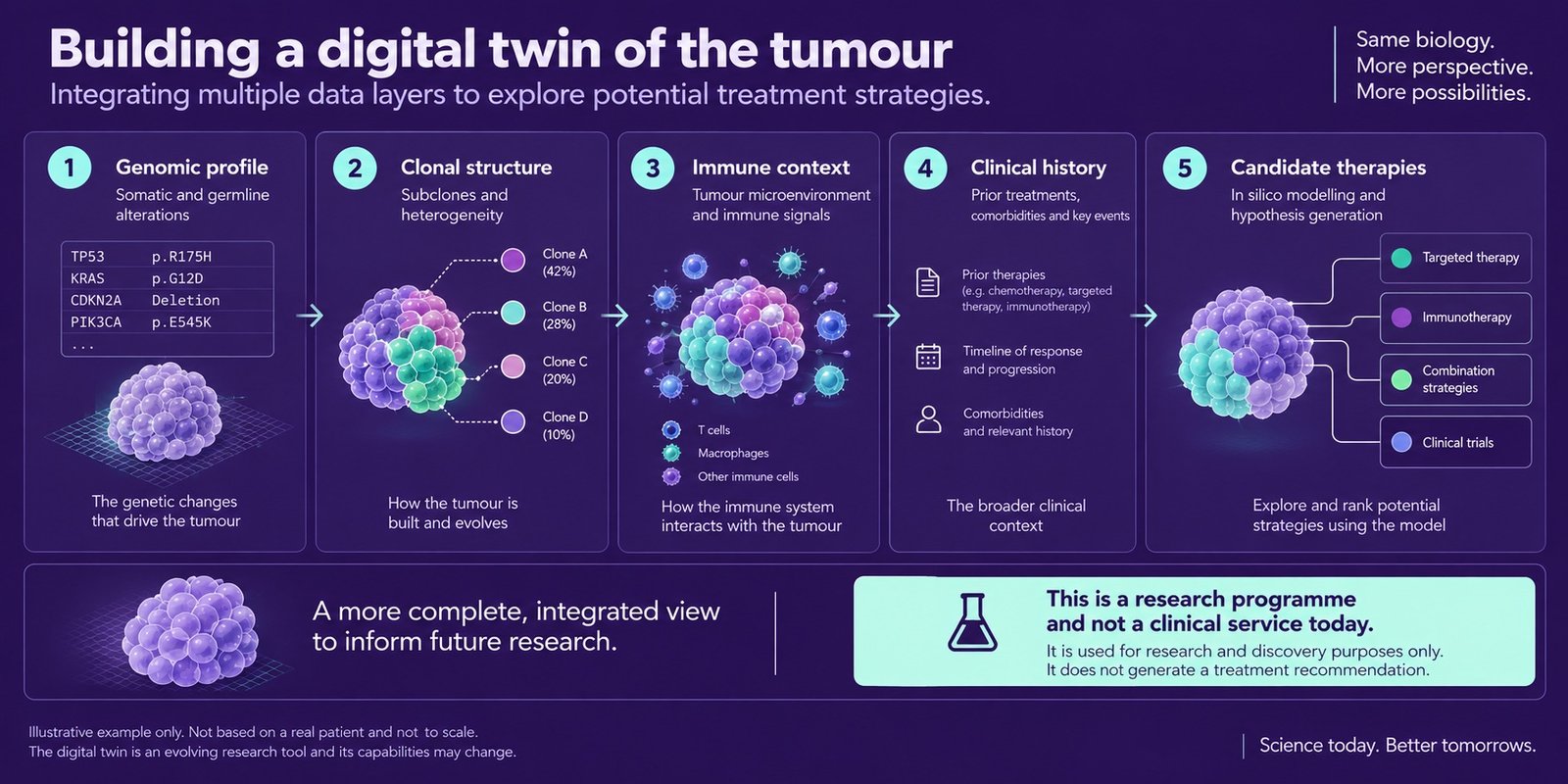
Comprehensive profiling, serial monitoring and the functional models in our pipeline all feed toward a validated computational twin of a patient’s cancer, in which candidate therapies can be explored in silico before they are given. It is a research programme, not a service, and it is years rather than months away.

A motion graphic building a computational model of a tumour layer by layer, then simulating candidate therapies against it.
A research programme, not a clinical service. Nothing in it informs a report we produce today.

Propose a collaborationSee the pipeline

Answered directly

Questions researchers ask us

No. Nothing leaves under any arrangement until an approved protocol and the relevant consents are in place. We would rather lose a collaboration than shortcut this, and a partner who pushes on it tells us something useful.

Consent for care and consent for research are separate and explicit. Research use requires its own consent, obtained separately, and participation is optional and does not affect anyone’s care.

We will tell you honestly at first contact, including when the answer is that it is too small for your question. A young company overstating its cohort size wastes everyone’s time, and the truth becomes obvious at analysis anyway.

Agreed in writing before work starts, including authorship order and what happens if results are unfavourable to us. If those conversations are uncomfortable, they are more uncomfortable later.

Yes, and we will say so in the agreement. Validation that can only produce good news is not validation.

No. Collaborations run on de-identified data. Where a question genuinely requires re-identification, that is a different kind of study with a different approval pathway, and the answer is usually to redesign the question.

It depends on what is involved. Academic collaborations frequently run at cost or below. Commercially sponsored work is priced. We will be clear which category a proposal falls into at the first conversation.

Take the next step

Three ways forward. Pick the one that fits today.

01

Book a free consultation

A no-obligation conversation with our care team, arranged through KPCIRC.

Book a consultation
02

Begin Blueprint Care

Commission your decision report and a dedicated clinical team.

Explore Blueprint Care
03

Ask on WhatsApp, free

Signal replies to your first question within four hours, at no cost.

Start with Signal